 Report Problem
 Translate
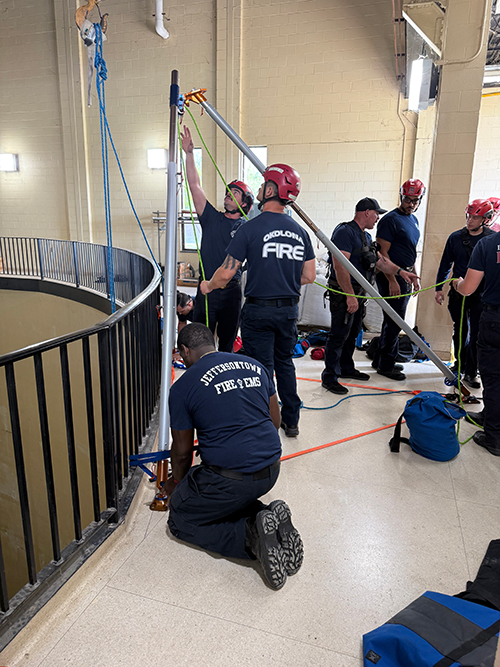
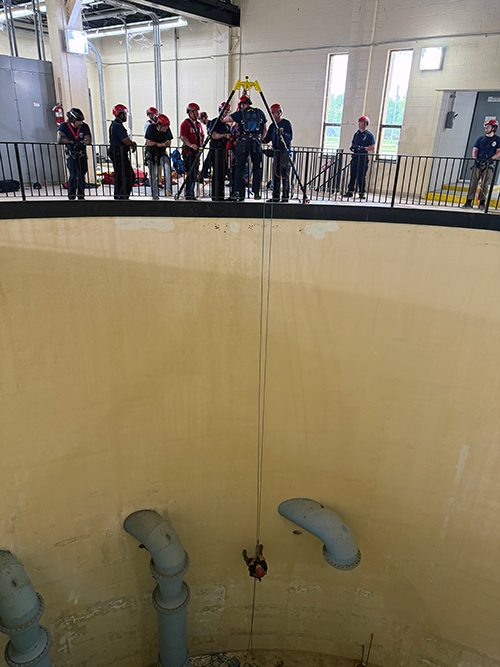
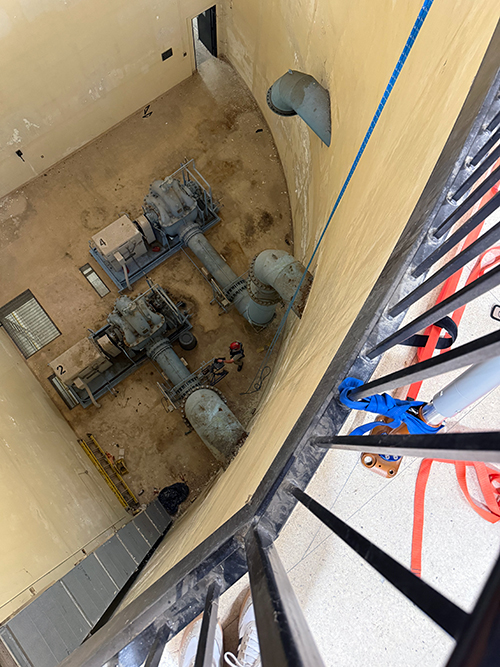
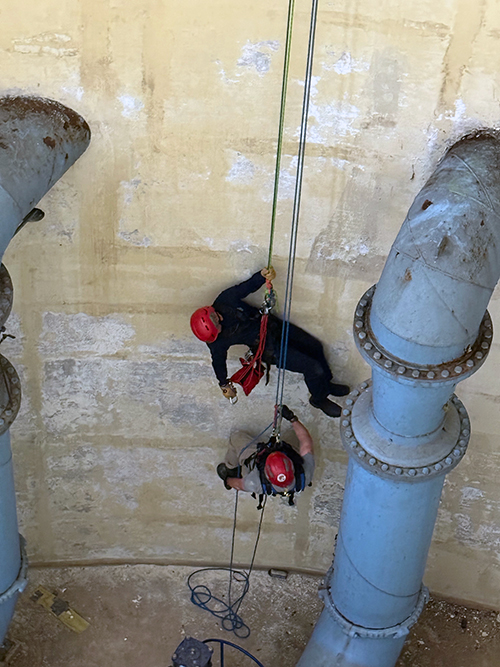
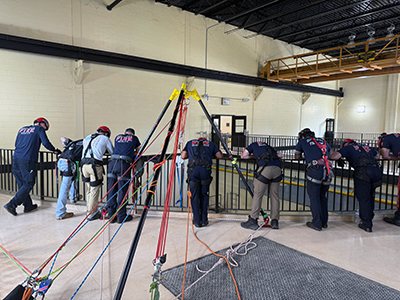 Firefighters clipped bright ropes into anchor points along railings and leaned back into open space 200 feet above the ground as an out-of-service pump station transformed into a vertical classroom.
There was no water flowing through the massive pumps inside Louisville Water’s B.E. Payne Water Treatment Plant, but the industrial structure remained – steel, concrete, ladders, and railings, along with tight spaces where a worker or civilian could become trapped.
“We were up seven or eight stories yesterday, and somehow this seems scarier,” one firefighter said.
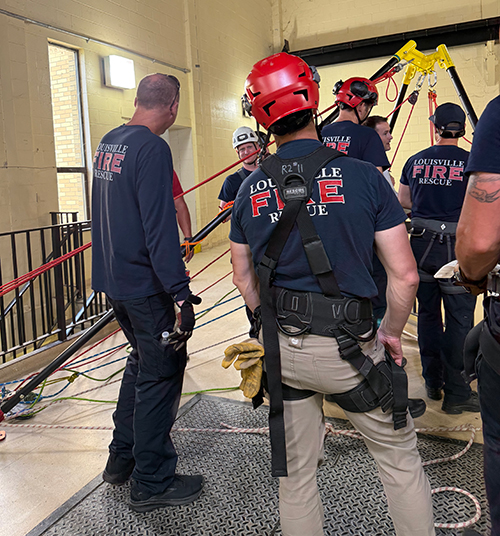
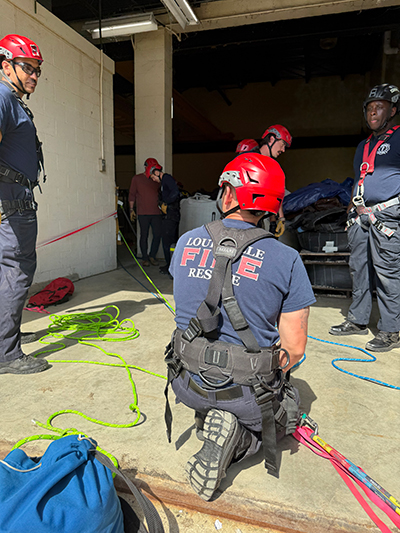
For five days, 25 Louisville Fire Department firefighters completed a 40-hour high-angle rope and technical rescue training course at the facility. The firefighters split into two groups and trained on opposite sides of the pump station under the supervision of Capt. Michael Renn.
Renn moved between the groups, checking rope systems, and pointing out hazards firefighters cannot fully understand in a classroom setting – blind spots over railings, sharp corners where ropes can snag, and confined spaces that can complicate a rescue.
“These 25 students are doing the above and beyond,” Renn said. “They’re learning the technical rescue side of things, and the high-angle rope world is the first thing they have to do that branches into everything.”
Training in real-world conditions
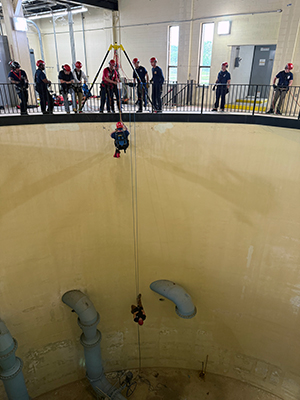 The partnership between Louisville Fire and Louisville Water allows firefighters to train inside real industrial facilities, helping them prepare for emergency situations they could encounter on the job.
Renn said height and structural complexity are key factors when selecting training locations.
“Height is always better,” he explained. “A place like this facility is amazing because we’re indoors. We’re out of the rain, out of the weather. We can rely on it. At the same time, training here gives us insight into hazards Louisville Water may have.”
The training benefits both organizations. Firefighters gain familiarity with the type of work environments Louisville Water employees operate in, allowing them to respond more effectively during an emergency.
“Louisville Water may have workers installing bolts or pipes, switching out a pump or doing maintenance,” Renn said. “Training in these facilities teaches our guys what to look out for.”
Matthew McCroskey, manager of environmental health and safety at Louisville Water, said making facilities available for training improves both public and employee safety.
“We never know when we may need the assistance of Louisville Fire,” McCroskey said. “Providing space for training benefits both organizations from a public health and safety standpoint, as well as employee safety operations.”
Louisville Fire has previously trained at several Louisville Water facilities, using them for vertical and horizontal confined space rescue scenarios and high-angle rope training.
Preparing for the “golden hour”
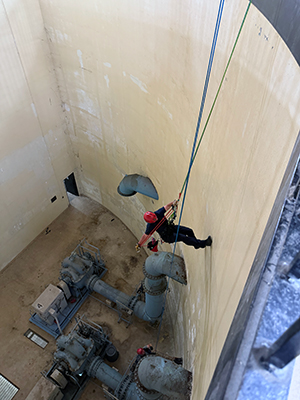 The training is designed to prepare crews for real-world rescues where time is critical.
Renn pointed to a recent rescue on Louisville’s Second Street Bridge, where firefighters were able to reach a trapped semi-truck driver, bring the person back to the road, and transport them to the hospital within 51 minutes.
“That’s the goal – within the hour,” Renn said.
Firefighters aim to build rescue systems within five to 10 minutes so they can operate quickly and safely during emergencies because every minute matters.
The goal, Renn said, is to make rescues efficient enough that crews can replicate “golden hour” performance when responding to incidents involving bridges, buildings, or workers who have fallen or become trapped.
A partnership rooted in safety
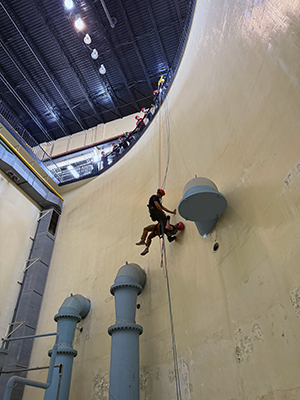 The relationship between Louisville Fire and Louisville Water dates back to 1860.
Louisville Water formed primarily for fire protection, supplying water to fight fires in a city filled with wooden rickhouses, homes, and businesses.
Today, Louisville Water maintains more than 25,000 fire hydrants across Louisville and works closely with the fire department to ensure they remain operational. Louisville Water crews have also trained firefighters on proper hydrant operation so they can prevent mistakes and fight fires more effectively.
“Both organizations exist to safeguard lives and property,” McCroskey said. “Louisville Water provides the pressure, flow and reliability Louisville Fire depends on.”
The training partnership expanded under Dave Simmons, Louisville Water’s former environmental health and safety manager and a volunteer firefighter with the Fern Creek Fire Department. Simmons recognized the need for firefighters to train in diverse environments and helped establish partnerships with multiple fire departments across the region.
Today, that collaboration continues, focused on shared responsibility for safety across Louisville Water facilities and our community.
“Essentially, we’re the ones who are going to be there if something ever happens,” Renn said.