 Report Problem
 Translate
 Although water sampling happens near the end of a main break repair, it’s the beginning of a critical process that involves its own series of exacting procedures.
A Louisville Water employee who often starts that process is Dwight Leupp. One time he started it by collecting a water sample while standing on ice in four inches of water when the temperature was one degree. (No, that’s not a typo!)
Collecting samples isn’t even his primary job. He’s a cross connection specialist, which means he spends most of his time making sure there aren’t any connections in Louisville Water’s system between potable (drinkable) and non-potable (not drinkable) water. He helps the company’s Distribution Water Quality (DWQ) team collect samples once a month “to give them a break,” he said.
He helped in January because snow, ice, and arctic air brought an especially high number of main breaks — more than 220, which means in one month we had roughly a third of the total number of breaks in our service area in a typical year.
A repair starts with emergency turners, who are “the superheroes that find the valves in the street and isolate the break away from the rest of the distribution system,” Leupp said. “Next on scene are the Before You Dig utility-marking people who spray paint all those red, blue, and yellow marks all over the roads and sidewalks and plant those little flags that tell the digging crews where not to dig because of other pipes and wires in the ground.”
Then a crew brings in saws and jackhammers to start the excavation so a backhoe operator can dig down to the pipe. The crew typically clamps the leak or cuts out the broken piece of pipe and replaces it.
Setting Up Sampling Points
After the crew finishes, they fill the hole they dug but set up flushing points upstream and downstream of the repair. Typically, a flushing point, or sampling point, is a fire hydrant, but sometimes it’s a meter in someone’s yard fitted with a “flushing tee.”
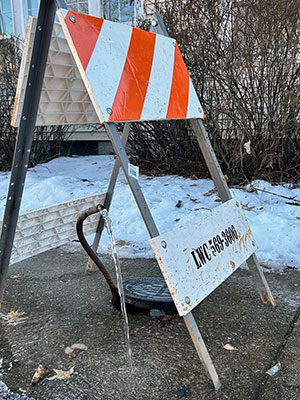 “If there’s a flushing tee installed, you’ll see a cone in the yard at the meter alongside a piece of copper pipe sticking out of the ground with water running out of it,” Leupp said. “Looks funny, but that’s on purpose.”
After the points are set, the crew leader sends his “flushing report” to Louisville Water’s radio room where the staff broadcasts it to several other employees. That’s where DWQ comes in. A team member goes to the site and collects water samples from the points noted in the report.
“This is a challenging winter [for sampling] due to the cold,” Leupp said. “Sometimes hydrant caps are frozen and need to be thawed with a propane torch. Sometimes we are running water while standing in it.”
“To collect the sample, we’ll completely bleach the tube or hydrant opening to assure we are sampling only our drinking water, all the while removing anything that is not our water from compromising that sample,” Leupp explained. “This is a precise practice, starting a chain of custody to the lab refrigerator, then the lab for processing at Crescent Hill Filter Plant.”
Meeting the Challenges
Scientist Andrew Ely recently worked until 8 p.m. to test the 41 water samples on the counter next to him in Louisville Water’s Crescent Hill lab.
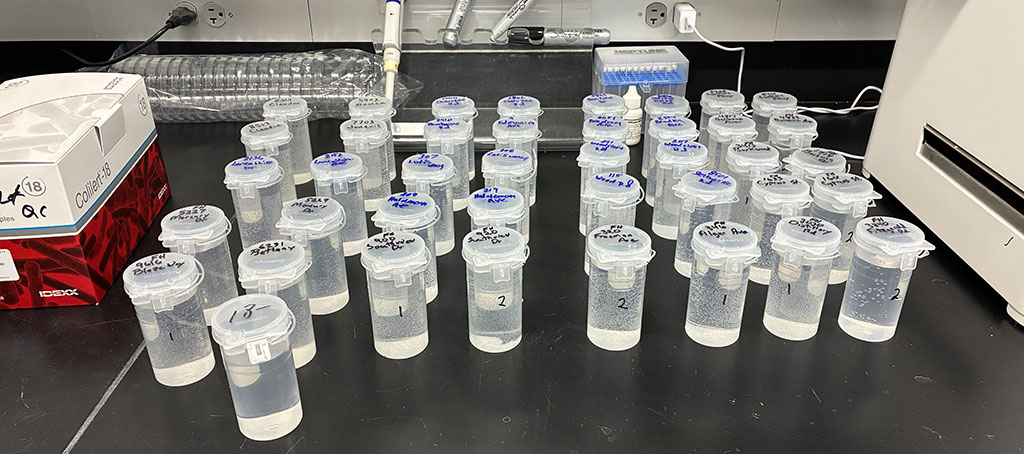
He gave a shout out to everyone involved in the main break repair process, including “our DWQ team for navigating the icy roads and maintaining proper sampling procedures despite the poor conditions, and to all the other individuals dealing with the additional workload.”
In all, the lab tested 357 samples in January. “This represents the second highest single-month sample volume in recent history — second only to January 2018,” Ely said. The recent winter weather brought several days with 40 or more main break samples on top of the regular daily distribution system samples.
“A high-volume influx of samples, especially for a sustained period like we are experiencing, certainly presents a challenge,” he added. “Managing the increased workload, keeping lab inventory and supplies stocked, maintaining lab quality control standards, and the sheer processing time required to analyze all the samples quickly adds up. Fortunately, our team comes prepared for the challenge, and everybody steps up to share and distribute the workload. With that said, I am definitely looking forward to warmer weather!”
Why is Testing Repaired Mains Important?
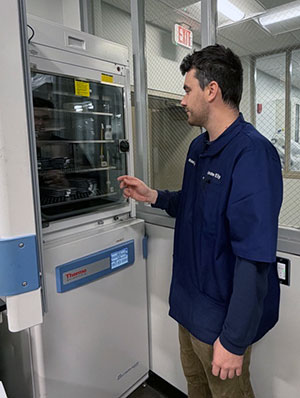 Testing is especially important after a main break because “there are federal and state regulations that set standards for drinking water quality,” Ely said. “Those regulations apply to both water as it’s being treated at the plant and to our treated water as it moves throughout our distribution system. Any damage to our system — such as from a main break or rupture — has the potential to negatively impact water quality. We perform specific tests to confidently determine that the quality and potability of the water in and around the affected area following a repair was maintained. In essence, our testing is crucial for demonstrating successful completion of repairs and restoration of water service, which preserves customer confidence, so they can continue to enjoy safe, clean drinking water.”
After a main is returned to service, there’s one more important step in the repair process: “When the lab gives the all clear to the radio room,” Leupp said, “then the clean-up crews go back to the site and make it look like we were never there.”